Our Academy Patron: Blessed Nicholas Postgate
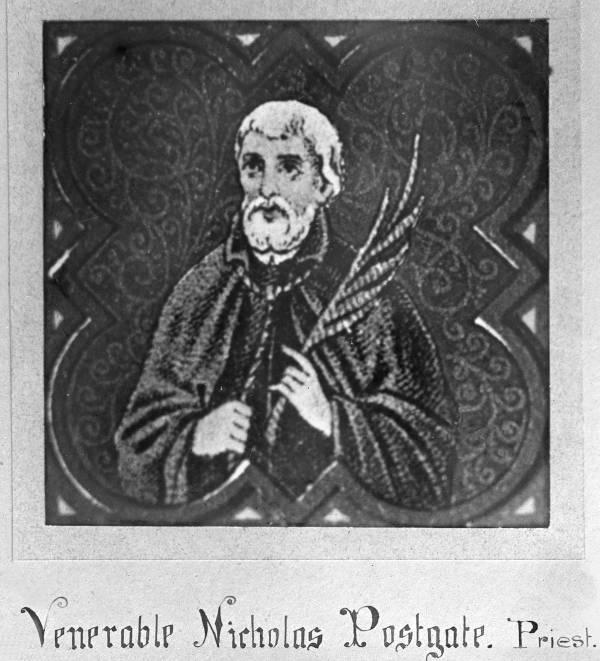
Nicholas Postgate was a Catholic priest during a period of more than 200 years when the Catholic faith was illegal in England. To practice as Catholic priest was classed as treason by an Elizabethan law.
The Nicholas Postgate story begins at Egton Bridge: a tiny village deep in the North York Moors beside the River Esk. He was born about 1599-1600 in Kirkdale House, which stood close to the new bridge which spans the Esk.
On July 4, 1621 he joined the English College at Douai, France, to train as a priest, in full knowledge of how dangerous this was at the time. All the Douai students used aliases (a different name) so that their families in England would not be punished and Postgate used the name Whitmore (probably based on Whitemoor, the opposite of the Blackamoor above his home). He later used his mother’s maiden name of Watson.
Some six years later, Nicholas passed his exams and on March 20, 1628, he was ordained priest.
Back in England, many people secretly remained Catholics and had hiding places called priest-holes built into their properties and made use of secret chapels. Many “employed” priests as gardeners, a useful disguise, and it is largely due to their actions that the Catholic faith survived in this country.
After a long journey home, finally, during the 1660s, Nicholas Postgate returned to his home patch in the North York Moors.
He was renowned for his humanity, his simple faith, his care of the poor and his holiness, becoming a friend of Catholic and Protestant alike, and for the next 20 years he walked the Moors and Eskdale, living in a humble home now called The Hermitage at Ugthorpe. It is said he planted the daffodils which flourish in the Esk Valley but throughout his work, he was at constant risk from the authorities.
Although anti-Catholic feeling had subsided a good deal, it flared up again due to the fake Popish Plot of 1678; this followed a false testimony from Titus Oates in which he claimed there was a conspiracy to install a Catholic king, and he managed to ferment a renewed and fierce persecution of English Catholics.
It was to be the last time that Catholics were put to death in England for their faith; one of the last victims – and not the very last – was Nicholas Postgate.
Father Postgate was to baptise the child of Matthew Lyth at Redbarns Farm, Ugglebarnby, near Whitby. The house was raided during the ceremony and the priest was caught, then aged 82. Between December 1678 and March 1679, he was locked in York Castle where he wrote a hymn, still sung at Egton Bridge and elsewhere.
On August 7, 1679, Father Postgate, a priest for 51 years, was strapped to a wooden sledge and dragged through the streets of York. In his final speech, Father Postgate said: “I die not for the plot, but for my faith,” and forgave those who had wronged him. His grave is unknown but the crucifix he wore at his death is now in Ampleforth Abbey.
Every year since 1974 an open-air service has been held – alternately in Egton Bridge and Ugthorpe – in honour of Fr Postgate.
He was beatified by Pope John Paul II in November 1987.
